Your Free Go-To-Market Template for SaaS: An Operator’s Playbook for Growth
 Published By: Alex
November 15, 2025
Published By: Alex
November 15, 2025
Here's your free go-to-market template—think of it as the central playbook for your entire launch. It's a simple downloadable file designed to bring clarity to the chaos of launching a SaaS product, ensuring your marketing, sales, and product teams are executing the same play from day one.
Why a GTM Template Is Your SaaS Launchpad
Launching a SaaS product without a clear plan is a gamble. You’ve built something great, but getting customers to find it, adopt it, and pay for it is a different discipline entirely. So many promising products fail to get traction, not because the tech was flawed, but because of disconnected teams, muddled messaging, and a blurry vision of the customer.
This is where a battle-tested Go-To-Market (GTM) strategy becomes your unfair advantage. The numbers are brutal. Of the 30,000+ new products that launch every year, an incredible 95% fail. A GTM template forces you to have the critical conversations upfront to sidestep the common traps that sink most ventures.
The Power of a Single Source of Truth
Stop thinking of a go-to-market template as just another spreadsheet. It's your command center. It’s the single document that aligns everyone toward the same objective. When sales, marketing, and product all operate from the same game plan, alignment stops being a buzzword and starts being your operational reality.
Instead of operating in silos, your teams can:
- Define the Ideal Customer Profile (ICP) with precision, so marketing generates leads that sales can actually close.
- Codify your value proposition and core messaging. This ensures every blog post, sales pitch, and product update tells the same cohesive, compelling story.
- Establish clear success metrics from the start, making it simple to track what's working and hold teams accountable to real outcomes.
This foundational alignment is the engine behind strategic planning for growth.
Your GTM template should be built on a few non-negotiable pillars to be truly effective.
Core Components of an Effective SaaS GTM Template
This table breaks down the essential pillars your GTM template must include for a successful SaaS launch.
| Component | Why It Matters for SaaS | Actionable Question to Answer |
|---|---|---|
| Target Audience (ICP) | Without a crystal-clear ICP, your marketing is a shot in the dark, and your product features might miss the mark. | Who feels the pain we solve most acutely, and what are their daily deal-breakers? |
| Value Proposition | This is your core promise. It’s how you differentiate in a crowded market and hook potential customers immediately. | In one sentence, why should our ideal customer choose us over everyone else (or doing nothing)? |
| Pricing & Packaging | For SaaS, this is everything. It directly impacts revenue, customer acquisition, and perceived value. | Does our pricing model align with the value our customers receive as they grow? |
| Marketing & Sales Plan | This is your "how." It outlines the specific channels, tactics, and funnels you'll use to attract, convert, and retain customers. | What are the first three channels we will use to get our first 100 paying customers? |
| Success Metrics (KPIs) | You can't improve what you don't measure. KPIs tell you if your strategy is actually working or just a nice theory. | What key numbers (e.g., CAC, LTV, Churn) will tell us if we are on the right track? |
Having these components clearly defined turns your GTM plan from a document into a powerful operational tool.
Turning Chaos into Clarity
Without a template, launch planning easily spirals into a mess of disconnected spreadsheets, endless Slack threads, and conflicting priorities. A good GTM template imposes order on that chaos. It gives you a tested framework to guide you through defining your audience, nailing your positioning, and mapping out your execution.
A GTM plan isn't about boxing you in or stifling creativity. It’s about focusing all that creative energy effectively. It makes sure every single thing your team does directly contributes to a successful launch that drives revenue and adoption.
While the template is your launchpad, it works best when you combine it with broader insights into proven SaaS growth strategies for long-term, sustainable scaling. This whole process turns your launch from a hopeful shot in the dark into a calculated, strategic mission, helping you avoid the classic mistakes that sink even the best SaaS ideas.
How to Make This GTM Template Your Own
A blank template is just a starting point. The real value is unlocked when you apply it to your specific launch. Let's ditch the abstract advice and walk through how a top operator would put this into practice.
Imagine we're rolling out a new AI-powered analytics feature for our project management tool. Our mission is to take this free go-to-market template and turn it into a concrete plan for this specific launch.
First, you'll need the template itself. I've used this exact framework for multiple 7-figure SaaS launches, and you can grab it here:
- Download the Google Docs version
- Duplicate the Notion version
Think of the template as the bridge between the chaos of launch ideas and a clear, structured plan that actually gets you there.
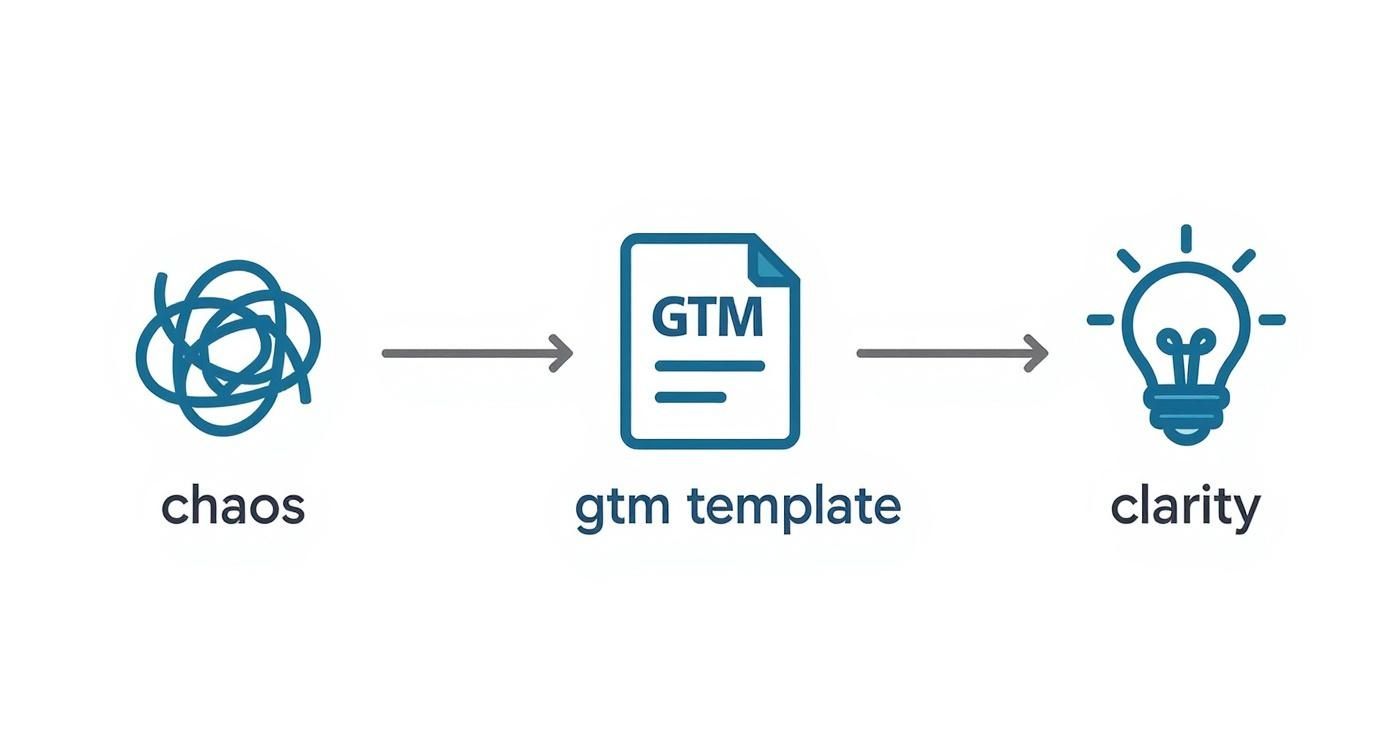
This is what we're aiming for: turning a jumble of tasks into a streamlined process.
Define Your Launch Tiers
Not every launch needs a Super Bowl ad. Top operators use a phased rollout to de-risk the launch and build momentum. For our AI analytics feature, we'll map out distinct tiers right inside the template. This breaks the entire launch into manageable stages.
- Alpha Launch (Internal): The feature is released to our internal 25-person team. The only goal is to find bugs. Success is measured by the number of critical issues identified and resolved before any customer sees it.
- Private Beta (Power Users): We hand-pick 50 of our most engaged customers for early access. The goal is to validate the feature's value and gather honest feedback. The key metric is qualitative feedback, not adoption.
- General Availability (GA): This is the official public launch. Our primary KPI is hitting a 15% adoption rate among our target user segment within the first 60 days.
This tiered approach ensures the product is solid and the value is confirmed before you go all-in on a public launch. Thinking through these stages early also helps clarify your strategy for feature prioritization and development.
Assign Clear Ownership with a RACI
A plan without owners is a wish list. To eliminate the "I thought you were doing that" problem, use a RACI matrix for every key milestone, right in the template. RACI stands for Responsible, Accountable, Consulted, and Informed.
For the "Private Beta Feedback Collection" milestone, the assignment is clear:
- Responsible: The Product Manager. They are doing the work—collecting, synthesizing, and reporting on customer feedback.
- Accountable: The Head of Product. The buck stops with them. They own the ultimate success of this milestone.
- Consulted: The Lead Engineer and Head of Customer Success. They are the experts looped in for input and technical feasibility.
- Informed: The CEO and Marketing Lead. They don't need to be in the weeds, but they are kept up to date on progress and key findings.
By assigning these roles for every major task—from writing the announcement blog post to training the sales team—you eliminate ambiguity. Everyone knows exactly what's expected of them, which is the secret to a smooth, coordinated execution.
This simple step transforms a generic document into a powerful playbook tailored specifically for your next big launch. It’s all about creating clarity so the team can focus on execution, not on figuring out who’s supposed to do what.
Nailing Your ICP and Product Positioning
A free go-to-market template is your canvas. The real art is filling it with a deep, obsessive understanding of your ideal customer and how your product fits perfectly into their world. This is where you go beyond fuzzy demographics and build a truly rock-solid Ideal Customer Profile (ICP).
Your ICP isn't just a list of job titles and company sizes. It's a living profile of the user who gets the most value from your product, has the highest retention, and becomes your best advocate. You want to get so specific that anyone on your team can close their eyes and picture this person.
Uncovering Deep Customer Pains
To get this right, you have to dig for the acute pain points that make someone open their wallet. This isn't about surface-level annoyances; it's about the deep-seated problems costing your customers time, money, or sanity.
Here are proven methods operators use to get to the truth:
- Run "Jobs to be Done" interviews. Don't ask customers what features they want. Instead, ask about the "job" they "hired" your product to do. A project manager isn't just buying a task management tool; she's hiring it to kill the constant anxiety of a missed deadline. That's the real job.
- Analyze your best customers. Isolate your top 10% of users—those with the highest engagement and lifetime value. What are their common firmographics and behaviors? What was the "aha!" moment that triggered their activation?
- Mine support tickets and sales calls. This is a goldmine of unfiltered language. Listen for the recurring frustrations, goals, and words customers use to describe their problems. This raw data is far more valuable than survey responses.
A laser-focused ICP is the cornerstone of product-market fit. To systematize this process, use our guide on building a PMF scorecard to measure how well your solution resonates with your target audience.
Crafting a Powerful Value Proposition
Once you know exactly who you're talking to, you must nail what you're saying. This is your product positioning. Great positioning cuts through the noise and makes your unique value instantly obvious.
Look at how Slack broke into a crowded market. They didn't sell "another chat tool." Their value proposition was built around a specific, painful outcome: "reducing email by 48.6%." They sold the cure, not the medicine. Figma did the same, positioning itself as the "first collaborative design tool," directly addressing the pain of designers working in siloed, offline files.
Your positioning statement needs to be so simple that any employee can recite it from memory. It’s the North Star for all your messaging, making sure everyone from sales to marketing to product is telling the exact same compelling story.
Building Your Messaging Matrix
To operationalize your positioning, build a messaging matrix directly into your go-to-market template. This simple grid ensures everyone on your team stays on-message, regardless of the channel or audience.
| Persona | Pain Point | Our Solution | Key Message |
|---|---|---|---|
| Marketing Manager | "I can't track campaign ROI easily." | Centralized dashboard with auto-tagging. | "See every campaign's true ROI in one place." |
| Sales Leader | "My team wastes time on bad leads." | Predictive lead scoring based on user behavior. | "Focus your team on leads that are ready to close." |
| Founder / CEO | "Are we investing in the right channels?" | Full-funnel attribution and cost analysis. | "Make confident budget decisions with clear data." |
This simple framework forces clarity. It gives every person on your team the exact words they need to articulate your product's value, making your GTM execution incredibly sharp and consistent.
Building Your GTM Action Plan
Strategy without execution is just a document. This is where your go-to-market template becomes a revenue-driving machine. The first step is to translate strategic goals into a concrete action plan, starting with selecting the right acquisition channels.
Your go-to-market motion—product-led growth (PLG) or sales-led—dictates your channel mix. If you're running a PLG motion with a free trial, model your approach after early-stage players like Notion or Calendly. They focused relentlessly on SEO, high-value content, and community building to drive organic sign-ups.
Conversely, a sales-led strategy targeting enterprise accounts will lean heavily on outbound sales, account-based marketing (ABM), and strategic partnerships.
Setting KPIs That Actually Matter
Vanity metrics like website traffic and total sign-ups feel good, but they don't predict revenue. Elite SaaS operators track KPIs directly tied to product adoption and revenue. Your action plan must be measured against numbers that prove users are getting real value.
Don't just track the sign-up. Measure what happens after.
Zero in on these metrics instead:
- Activation Rate: What percentage of new users experience the "aha!" moment in their first session? For a project management tool, this could be creating a project and inviting a teammate. That is activation.
- Customer Acquisition Cost (CAC): How much do you spend in sales and marketing to acquire one paying customer? This number keeps your growth engine economically viable.
- Net Revenue Retention (NRR): This is the ultimate health metric for a SaaS business. It measures revenue growth from your existing customer base, factoring in upgrades, downgrades, and churn. An NRR over 100% means your business grows even without adding a single new customer.
Having a structured plan built around solid metrics like these makes a massive difference. In fact, research shows companies with a formal go-to-market strategy see 10% higher success rates and can achieve up to three times greater revenue growth.
Build a Simple GTM Scorecard
Accountability is non-negotiable. To keep the team focused on results, build a simple GTM scorecard right inside your template. This isn't a complex dashboard; it's a focused snapshot of the key metrics you just defined.
A GTM scorecard isn't for micromanagement. It’s about creating a shared, data-driven definition of "winning." When everyone knows the score, they can make smarter decisions autonomously.
Your scorecard should have clear owners and targets for each metric. It's that simple.
| Metric | Owner | Target |
|---|---|---|
| Weekly Activations | Product Team | 250 |
| CAC | Marketing Team | < $450 |
| NRR (Quarterly) | CS Team | 105% |
This simple table is a powerful tool for aligning the entire company around the success of your launch.
As you start prepping all the moving parts of your launch, our comprehensive product launch checklist can give you a super detailed breakdown of every task. And once your Go-to-Market plan is dialed in, mastering effective marketing strategy implementation is the final, crucial step to bring it all to life.
Sidestepping the Usual Go-To-Market Potholes
https://www.youtube.com/embed/oRB-np3SyGo
Even the most well-crafted go-to-market template will face real-world friction. Launching a SaaS product is never a straight line. The best operators aren't those who hope for a smooth ride; they are the ones who anticipate challenges and have a playbook ready.
The biggest hurdle you'll face is almost always internal. The silent killer of GTM plans is a lack of cross-functional alignment. When product, marketing, and sales run separate plays, you get muddled messaging, duplicated effort, and a disjointed customer experience. The data proves it.
A recent report on GTM challenges revealed that a staggering 33.3% of GTM leaders cited 'alignment and buy-in' as their single biggest challenge. Another 21.6% pointed to the need for a clearer strategy—a direct symptom of poor alignment.
The message is clear: getting everyone rowing in the same direction isn't a soft skill. It's the most critical function of a GTM leader.
Closing the Gap Between Product, Marketing, and Sales
So, how do you operationalize alignment? The answer lies in creating shared goals and rituals that force collaboration. Don't just email the GTM doc and hope for the best. Weave it into your weekly operations.
- Run Weekly GTM Huddles: Get leads from product, sales, and marketing together for 30 minutes every week. The only agenda item is reviewing the GTM scorecard. This keeps the conversation focused on data, not opinions.
- Create a Shared "Definition of a Qualified Lead": This is a classic source of friction. Lock marketing and sales in a room until they agree on a simple, one-page document that defines exactly what makes a lead sales-ready. This single action can eliminate months of finger-pointing.
- Schedule "Ride-Alongs": Mandate that PMs and marketers listen to real sales and customer success calls every month. Nothing replaces hearing unfiltered customer feedback and objections straight from the source.
What to Do When Your Channels Fizzle Out
Another inevitable roadblock is when an initial marketing channel underperforms. You were certain LinkedIn ads were your golden ticket, but your customer acquisition cost (CAC) is through the roof.
Do not panic. Iterate, don't abandon. You need a system for diagnosing the problem. A great framework for this is to learn how to perform a gap analysis, which helps you isolate the point of failure.
Is it the channel, the audience, or the message? Test one variable at a time. Tweak the ad creative while keeping the audience the same. If that fails, test a different audience segment on the same channel. Only consider abandoning a channel after you have systematically exhausted the messaging and audience variables.
Building a resilient GTM process isn't about avoiding problems—it’s about having a playbook ready to solve them when they inevitably arise.
Got Questions About the GTM Template? We've Got Answers
Even with a solid playbook, questions will come up. Here are answers to the most common questions SaaS operators ask when implementing a go to market template, designed to help you turn this document into a revenue-driving asset.
"So, How Early Should We Actually Start Filling This Out?"
The answer is simple: the moment a new product or major feature is greenlit. Too many teams wait until the product is nearly code-complete. By then, it's too late.
Your GTM plan is not a post-launch checklist; it is a strategic compass that should influence product development. Working on it early forces critical conversations about the Ideal Customer Profile and messaging. Those insights must feed back into the feature development and prioritization process.
"Is This Just a One-And-Done Document?"
Absolutely not. A GTM template must be a living document. The plan you start with is rarely the one you finish with. Markets shift, customer feedback surprises you, and initial assumptions will be proven wrong.
When a marketing channel you banked on doesn't deliver, your template is where you document that learning, pivot the strategy, and reallocate the budget to what is working. It should be reviewed and updated constantly, especially during your weekly GTM huddles.
The value of a GTM template isn’t in creating a perfect plan on day one. It's in providing a framework to adapt quickly and make data-driven decisions when—not if—things go sideways.
"How Deep in the Weeds Should We Get with This Plan?"
Find the sweet spot: detailed enough for clarity, but not so rigid it kills agility. Do not try to plan every single tactic, tweet, and email six months in advance. That is a waste of time.
Instead, lock in the strategic pillars first. Get these core components right:
- Clear Ownership: Who is the Directly Responsible Individual (DRI) for every major task? No ambiguity.
- Success Metrics: Define winning with numbers. "Achieve a 15% activation rate in Q1," not "get new users."
- Core Messaging: Codify the key value propositions for each persona so clearly that anyone on the team can repeat them.
With these pillars in place, you provide the strategic foundation your team needs to make smart tactical decisions on their own. The specific blog post titles and ad copy can be filled in later.
Ready to stop launching products and hoping for the best? SaaS Operations is packed with proven, plug-and-play playbooks and templates just like this one. You can save time, ditch the guesswork, and grow faster with frameworks built by operators who've scaled multiple 8-figure businesses. Start running your SaaS more effectively today.