
A free GTM template is a good start. But let's be clear: a successful SaaS launch requires more than a document—it demands an actionable strategy. "Winging it" is the fastest way to burn cash targeting the wrong audience with a message that falls flat. This guide provides the framework and exact next steps to build a structured plan that sidesteps those costly mistakes.
Why Winging Your SaaS Launch Is a Costly Mistake

I've seen it a hundred times: launching a SaaS product based on a hunch is a recipe for disaster. It feels liberating at first—you're moving fast, breaking things. But that energy vanishes when you realize you're operating without a map. Without a structured Go-to-Market (GTM) strategy, you're not just missing a few pieces of the puzzle; you're building your entire launch on pure guesswork.
This "no-strategy" approach is alarmingly common, especially with first-time founders who are brilliant product people but inexperienced operators. They fall into the trap of believing a great product sells itself. In today's crowded SaaS market, that’s a dangerous fantasy.
The Real-World Fallout of a Poor Launch
The fallout from an unstructured launch is always painful and expensive. I've personally watched SaaS operators torch their entire marketing budget in a few months, chasing an audience that was never going to buy. They were left with abysmal conversion rates, minimal trial sign-ups, and a completely demoralized team.
Another classic pitfall is a chaotic message. When there's no GTM plan to anchor everyone, different teams invent their own version of the product's value. Marketing sells a time-saving tool while sales pitches a collaboration platform. Customers get confused by the mixed signals and, unsurprisingly, they walk away.
"The biggest mistake we made with our first product was assuming everyone would 'get it.' We didn't define our ideal customer, so our ads were generic, our content was vague, and our sales demos were all over the place. We learned the hard way that clarity is everything."
– Founder of a B2B Analytics SaaS
The Power of a Structured Framework
A proper GTM strategy is your operational playbook—it's what keeps you from driving off a cliff. It forces you to answer the hard questions before you spend a single dollar on ads. More importantly, it aligns your entire company, from product to sales to support, ensuring everyone marches in the same direction. That alignment isn't just a "nice-to-have"; it's a direct driver of revenue.
There's a reason GTM templates have become so essential for product launches: they provide a repeatable process. In fact, companies with data-driven GTM teams that are fully aligned are twice as likely to hit their revenue goals. That single data point should tell you everything you need to know about why a structured plan is mission-critical.
A free GTM template provides the foundational structure to avoid these preventable mistakes. It’s the starting point for building a launch based on data, not just gut feelings.
- Actionable Step: Define your Ideal Customer Profile (ICP) with extreme precision. Don't stop at "small businesses." Define the industry, company size, and the specific role of the buyer.
- Actionable Step: Write a one-sentence value proposition and get every single team member to agree on it. This ensures unified messaging from the start.
- Actionable Step: Allocate your budget based on the channels where your ICP actually spends their time, not where you think they are.
Ultimately, a GTM plan isn't about adding bureaucracy; it's about being intentional. It's the difference between a scattergun launch and a laser-guided one. To ensure all your bases are covered, you can also use our comprehensive product launch checklist.
Meet Your AI-Powered GTM Strategy Co-Pilot

Let's be honest. Most free GTM templates are just glorified spreadsheets. They're static, generic checklists that put all the strategic heavy lifting on your shoulders. You get the "what," but you're left to figure out the "how" and "why" for your specific business. We knew there had to be a better way.
So we built one. Our GTM Strategy Template Generator isn't just another document—it’s an intelligent tool that acts as your strategic partner. We designed it to be an interactive co-pilot, helping you build a launch plan grounded in your unique operational reality. Instead of just handing you a file, our generator uses AI to give you a playbook and exact next steps.
It prompts you for specific details about your SaaS product—your industry, audience, goals—and then transforms your answers into a genuinely tailored playbook. The goal is to create a living strategy, not just fill in blanks.
From Simple Inputs to a Strategic Playbook
Getting started is refreshingly simple. We don't need you to dump pages of data; all it takes are the core details that define your launch. You provide a few key inputs, and the AI uses them to start building your initial framework.
The generator will ask for things like:
- Your Industry: Are you building for FinTech, MarTech, or another niche?
- Target Audience: Who are you really trying to reach? What does your Ideal Customer Profile (ICP) look like?
- Key Business Goals: What does a "win" look like for this launch?
Once you've answered, the AI gets to work. It synthesizes everything and generates a custom GTM plan that feels like it was built from scratch just for you—because it was. This isn't just about moving fast; it’s about creating something relevant. This approach to using AI for strategic automation is a cornerstone of how we see modern SaaS operations evolving.
The real magic happens when you see your straightforward answers turned into a cohesive strategy. The generator connects the dots between your product, your audience, and the market, giving you a clear path forward that a static template never could.
What Your Customized GTM Plan Includes
After the AI does its thing, you get a comprehensive GTM playbook—not some vague outline. It’s a detailed plan with distinct sections covering everything from your market positioning to the nitty-gritty of execution. We designed the output to be immediately actionable, so your team can align quickly and start making progress with confidence.
Get your own AI-powered free GTM template by visiting our GTM Strategy Template Generator. In just a few minutes, you’ll have a personalized playbook with clear, actionable steps to guide your launch. It’s the fastest way to turn a great idea into a concrete plan.
What’s Inside the GTM Template? A Look Under the Hood
A winning Go-to-Market strategy isn't one big document—it's a series of crucial decisions that click together to build momentum. Think of it like an engine. Every part has a job, but it’s how they fire in unison that creates real power.
Our free GTM template is built to walk you through each of these critical components, ensuring nothing falls through the cracks. Let's pull back the curtain on the core pillars that make it work.
Here's a quick overview of what the GTM template covers and why each part is so important.
GTM Template Core Components Breakdown
| Template Section | Core Purpose | Key Question to Answer |
|---|---|---|
| Ideal Customer Profile (ICP) | To define exactly who you are selling to with extreme clarity. | Who feels the pain we solve most acutely and has the ability to buy? |
| Value Proposition | To articulate the unique, tangible benefit your product delivers. | In a single sentence, why should our ICP choose us over anyone else? |
| Pricing & Packaging | To align the cost of your product with the value it provides. | How can our pricing model encourage adoption and scale with customer success? |
| Launch Plan | To coordinate all marketing, sales, and product activities for release. | What are the key milestones and channel activities needed for a successful launch? |
| Handoff SOPs | To create seamless transitions between marketing, sales, and success. | How do we ensure no lead or new customer gets dropped between teams? |
| KPI Scorecard | To measure what matters and track progress against goals. | What are the top 3-5 metrics that will tell us if this GTM plan is working? |
Each of these sections builds on the last, creating a comprehensive and actionable plan. Let’s dive a little deeper into the foundational elements.
Nailing Your Ideal Customer Profile
Before you write a line of code or an ad, you must know exactly who you're building for. Your Ideal Customer Profile (ICP) isn’t a vague persona like "small businesses." It’s a razor-sharp definition of the perfect-fit company that gets massive value from your product—and in turn, gives you the most value back.
This goes way beyond basic demographics. You need to understand their operational headaches, their business goals, and the trigger events that send them searching for a solution like yours.
- Firmographics: Industry, company size, annual revenue.
- Technographics: What software are they already paying for? What does their tech stack look like?
- Behavioral Data: How do they buy? Is it a top-down enterprise sale or a bottom-up, product-led adoption?
Consider Slack's early days. They didn't target every business. Their first ICP was laser-focused: tech companies, specifically development teams fed up with clunky chat tools. That sharp focus allowed them to build features and a message that resonated deeply, creating a rabid fanbase before they expanded.
Crafting a Value Proposition That Actually Sticks
Now that you know who you're selling to, you have to nail what you're selling. Your value proposition is the clear, punchy statement that explains the unique benefit you deliver. It must answer one simple question for your ICP: "Why should I care?"
A weak value prop is a surefire way to kill a launch. If you can't explain your value in one sentence, don't expect customers to figure it out. The best ones connect product features directly to your ICP's biggest pain points.
Actionable Step: Stop listing features. No one cares about "AI-powered analytics." They care that you can help them reduce customer churn by 15%. Always lead with the outcome.
Miro nails this. Their value proposition is "The online collaborative whiteboard platform to bring teams together, anytime, anywhere." It’s simple, outcome-focused, and speaks directly to the struggles of remote and hybrid teams.
Building a Pricing Strategy That Drives Growth
Pricing is one of the most critical parts of your GTM strategy. It isn't just about covering costs; it’s a strategic lever for positioning, customer acquisition, and adoption. Your pricing must align with the value your customers get.
Common models include:
- Freemium: Ideal for product-led growth (PLG) to attract a massive user base quickly.
- Tiered Pricing: Offers different packages based on features or usage to serve multiple segments.
- Per-User Pricing: Simple and predictable, a go-to for collaboration tools.
- Usage-Based Pricing: The cost scales as the customer uses more, tying price directly to value.
The explosion of PLG is a direct result of a shift in B2B buying behavior. Today, 75% of B2B buyers prefer not to talk to a salesperson. This is precisely why freemium and free trial models are dominating the SaaS world.
These three pillars—ICP, Value Proposition, and Pricing—are the bedrock of your launch. To see how these fit into the bigger picture, it’s worth understanding A Modern Go-to-Market Strategy Framework. Getting these right will dictate which features you prioritize, what marketing channels you invest in, and how your sales team approaches prospects. They are also central to making tough roadmap decisions, a process we cover in our guide to effective feature prioritization for SaaS companies.
Turning Your Strategy Into a Launch Playbook
A brilliant strategy is worthless if it just sits in a Google Doc. The real magic happens when you turn those high-level ideas into a practical, day-to-day playbook that your sales and marketing teams can actually use. This is where we shift from the "what" and "why" to the nitty-gritty "how"—building the engine that will truly power your launch.
This flow shows exactly how the core pieces of your strategy—your ideal customer, your value prop, and your pricing—should feed directly into how you execute your launch.
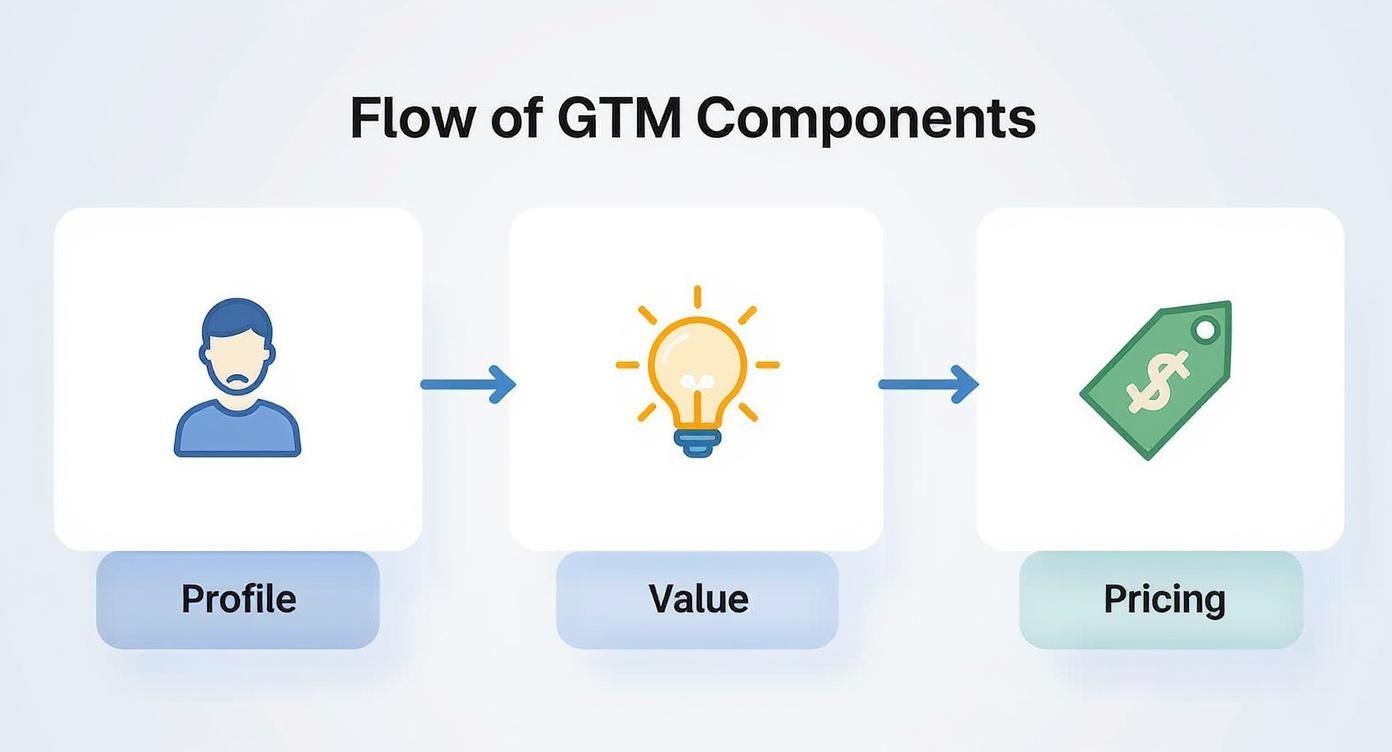
When each element informs the next, you keep your tactics perfectly aligned with your core strategy. A solid playbook like this is your best defense against the all-too-common scenario where marketing and sales end up running in completely different directions.
Mapping Your Pre-Launch Content Calendar
Your launch doesn't begin on launch day. It starts weeks, or even months, beforehand with a pre-launch content calendar. The goal here is to build buzz and warm up your audience by systematically educating them about the problem you solve—long before you ever ask for their credit card.
I once advised a B2B project management SaaS that executed this playbook perfectly. For two months before launch, they published content only about the headaches of managing creative teams. They hosted webinars on resource allocation, dropped blog posts on messy client feedback loops, and offered free templates for project briefs.
By the time they announced their product, they weren't pitching to a cold audience. They had already built a small, dedicated community that viewed them as the experts. The product felt less like a sales pitch and more like the logical solution to problems they'd been discussing together for months.
Actionable Step: Own the problem, not just the solution. When your Ideal Customer Profile (ICP) thinks about their biggest challenge, your brand should be the first one that comes to mind.
Selecting the Right Marketing Channels
Don't fall into the trap of trying to be everywhere at once. A focused GTM strategy pinpoints the one or two channels where your ideal customers actually live. Spreading your budget thinly across a dozen platforms is a rookie mistake that guarantees mediocre results.
- For Product-Led Growth (PLG): Focus on SEO-driven content and targeted ads on review sites like Capterra or G2 to drive qualified traffic directly into your free trial or freemium plan.
- For Targeted Content Plays: Selling to enterprise HR leaders? Go all-in on LinkedIn and industry-specific forums. Create high-value content like original research reports or in-depth guides that tackle their specific pain points.
- For Outbound-Heavy Models: For high-ticket enterprise sales, marketing's job is to arm sales with killer assets: compelling case studies, sharp one-pagers, and ROI calculators to make their outreach irresistible.
The free GTM template you get from our AI GTM Strategy Template Generator will help you identify the best channels by analyzing your specific industry and audience, giving you a playbook with clear next steps.
Defining a Seamless MQL-to-SQL Handoff
One of the most common—and costly—breakdowns in any GTM plan happens at the handoff between marketing and sales. A Marketing Qualified Lead (MQL) is useless if the sales team doesn't trust it or know what to do with it.
Your playbook needs an airtight Standard Operating Procedure (SOP) for this critical moment.
Sample MQL Handoff SOP:
- MQL Trigger: A lead becomes an MQL after they download our "Pricing Comparison Guide" and have visited the pricing page twice in one week.
- Automation: The lead is automatically routed to a sales rep in the CRM based on territory. An internal notification is sent to the
#new-mqlsSlack channel. - SLA: The assigned rep must make initial contact (via a personalized email) within 4 business hours.
- Qualification: The rep uses the "Discovery Call Checklist" to qualify the lead before converting them to a Sales Qualified Lead (SQL).
This simple process eliminates guesswork and ensures valuable leads don't fall through the cracks. For a deeper dive into turning strategy into a real-world plan, A Modern B2B SaaS Go To Market Strategy Playbook offers some fantastic, in-depth examples.
Turning your strategy into a concrete plan of action is what separates the launches that take off from the ones that fizzle out. For more battle-tested frameworks, explore our library of SaaS playbooks built to help you create repeatable growth processes.
Measuring What Matters for GTM Success
https://www.youtube.com/embed/5RR6M_d6eKc
How do you know if your launch is working? A flashy new product and a packed marketing calendar can feel like success, but feelings don't keep the lights on. This is where we get serious about accountability and measurement.
You need a straightforward GTM scorecard to track the key performance indicators (KPIs) that truly move the needle. Forget vanity metrics like social media likes. We’re going after the numbers that signal real, sustainable growth.
Think of your GTM plan as a living strategy. You must be ready to tweak and optimize it based on what real performance data is telling you.
Building Your GTM Scorecard
Your GTM scorecard is your single source of truth. It can be a simple spreadsheet or a dedicated dashboard, but its job is to track a handful of vital metrics that tie directly back to your GTM goals.
Start with the big three that every SaaS operator must obsess over:
- Customer Acquisition Cost (CAC): How much do you spend in sales and marketing to land one new paying customer?
- Lifetime Value (LTV): What’s the total revenue you can reasonably expect from a single customer?
- CAC Payback Period: How many months does it take for a new customer to generate enough revenue to cover their acquisition cost?
The golden rule is to keep your LTV at least 3x your CAC. If it costs you $500 to acquire a customer worth only $600, you have an expensive hobby, not a sustainable business. Tracking these numbers is non-negotiable.
Core Metrics for SaaS Launch Success
Beyond the foundational LTV:CAC ratio, a few other metrics are critical for seeing the immediate impact of your launch. These KPIs are your early warning system.
Top-performing SaaS companies religiously track their trial sign-ups, aim for a trial-to-paid conversion rate of around 30%, and fight to keep customer churn below 5% monthly. As you can find out from more insights about go-to-market strategy on Salesmate.io, this visibility makes or breaks growth.
Your GTM scorecard must include:
- Trial-to-Paid Conversion Rate: What percentage of free trial users become paying customers? This is a direct reflection of your product's value.
- Monthly Recurring Revenue (MRR): The predictable revenue your business generates every month. It's the lifeblood of any subscription company.
- Customer Churn Rate: What percentage of your customers cancel their subscriptions each month? High churn is a silent killer that can undermine all your growth efforts.
A low trial-to-paid conversion rate is often the first sign of a major disconnect. It means your marketing promise isn't matching the in-product experience. If this number dips, it's an immediate signal to dive deep into user feedback and your onboarding flow.
Interpreting the Data and Making Smart Pivots
Collecting data is the easy part. The real work is interpreting it to make smart decisions. Don't just stare at the numbers—ask what story they're telling you.
Is your CAC creeping up? Maybe an ad channel has lost its edge. Did your churn rate spike last month? Dig in. Did you ship a buggy feature or make a confusing pricing change?
This is why having a clear scorecard is so powerful. It connects your day-to-day activities directly to business outcomes, allowing you to make data-informed pivots instead of just guessing. For an even deeper dive, check out our guide on the most important SaaS KPIs to track for growth. This data is what empowers you to constantly refine your free GTM template and build a strategy that lasts.
Common GTM Questions from SaaS Operators
Even with a perfect plan on paper, launching a new SaaS product can feel daunting. Having worked with hundreds of SaaS operators, I can tell you a few key questions always surface as they dig into a GTM template.
Here are the most common ones, along with some no-fluff, actionable answers.
How Long Does It Take to Build a GTM Strategy with a Template?
For a small to mid-sized SaaS company, you can create a solid first draft of your GTM strategy in 1-2 weeks of focused work. While our AI generator provides the skeleton in minutes, the real work happens when your team adds the operational details.
Don't speedrun this. Carve out dedicated time for:
- Customer Research: Truly getting into the heads of your customers.
- Positioning Workshops: Nailing your messaging and differentiation.
- Pricing Discussions: Ensuring price matches the value provided.
The template provides the guardrails, but the quality of your plan comes from the deep thinking your team puts into it.
Pro Tip: Don't cram GTM planning into a single marathon meeting. A good strategy needs room to breathe. Give your team time to debate, research, and truly align.
Can I Use This GTM Template for a New Feature Launch?
Absolutely. The core principles of a successful launch are the same, whether it’s a new product or a game-changing feature. You can easily adapt this free GTM template for a feature release.
You’ll still need to define the feature's target audience (which may be a segment of your current users), create messaging that highlights its value, and map out a custom launch plan (e.g., in-app pop-ups, targeted emails, a "how-to" webinar). And, of course, you'll need to decide how to measure success, such as feature adoption rate or its impact on churn.
What Is the Biggest Mistake People Make with GTM Templates?
The biggest mistake is treating the GTM strategy like a one-and-done checklist. A great GTM plan is a living document, not a static PDF you file away after launch day. The market shifts, customer feedback floods in, and your product evolves.
The smartest SaaS operators review their GTM plan at least quarterly. They use it as their North Star to ensure daily activities still align with big-picture goals. Don't let your hard work gather digital dust; use it to stay sharp and adapt.
Ready to stop using generic templates and build a strategy that's truly yours? The SaaS Operations AI-powered generator creates a custom GTM playbook based on your specific business. Get a free, actionable GTM plan and crystal-clear next steps in minutes.
Start building your winning GTM strategy now with our AI GTM Strategy Template Generator.