Top Business Process Improvement Techniques for SaaS in 2025
 Published By: Alex
August 26, 2025
Published By: Alex
August 26, 2025
In the competitive SaaS landscape, a stellar product is just the price of entry. Sustainable growth and long-term profitability are built on operational excellence. The efficiency of your internal systems, from customer onboarding to development pipelines, directly impacts user experience, churn rates, and your bottom line. How you deliver value is just as crucial as the value you deliver. Inefficient workflows create friction, delay feature releases, and burn through resources that could be better spent on innovation.
This guide moves beyond theory to provide a practical playbook on business process improvement techniques tailored for SaaS operators. We'll explore 10 powerful methodologies designed to solve common challenges like reducing support ticket resolution times, streamlining user acquisition funnels, and accelerating your development lifecycle. Understanding the fundamentals of these different approaches is a critical first step. For a broader overview, you can explore some of the top process improvement techniques available to modern teams.
Instead of generic advice, you'll find actionable steps and SaaS-specific examples for implementing frameworks like Six Sigma, Kaizen, and Process Mining. Mastering these methods will equip you to build a more resilient, scalable, and profitable company. Let's dive in.
1. Six Sigma
Six Sigma is a highly disciplined, data-driven methodology designed to eliminate defects and reduce variability in any business process. Originating at Motorola in 1986, this technique aims for near-perfection, targeting no more than 3.4 defects per million opportunities. It achieves this by following a structured, five-phase framework known as DMAIC: Define, Measure, Analyze, Improve, and Control.
For a SaaS company, Six Sigma can be applied to critical processes like customer onboarding, support ticket resolution, or software development cycles. For instance, you could use it to drastically reduce the number of bugs that make it into a production release or to shorten the average time it takes to resolve a high-priority customer support ticket. The core idea is to use statistical analysis to pinpoint exactly where and why errors occur, then implement precise, measurable improvements.
How to Implement Six Sigma
Successfully adopting this powerful business process improvement technique requires a methodical approach.
- Secure Leadership Buy-In: Six Sigma projects require resources and organizational change. Ensure your leadership team fully supports the initiative.
- Invest in Training: Proper training in the DMAIC methodology and statistical tools is crucial. Certifications like Green Belt or Black Belt can equip your team with the necessary skills.
- Start Small: Begin with a high-impact process that has readily available data, such as improving your customer churn rate analysis or streamlining the lead-to-conversion funnel. Celebrate early wins to build momentum and prove the concept's value.
The following infographic illustrates the core DMAIC process, which is the engine behind Six Sigma's effectiveness.
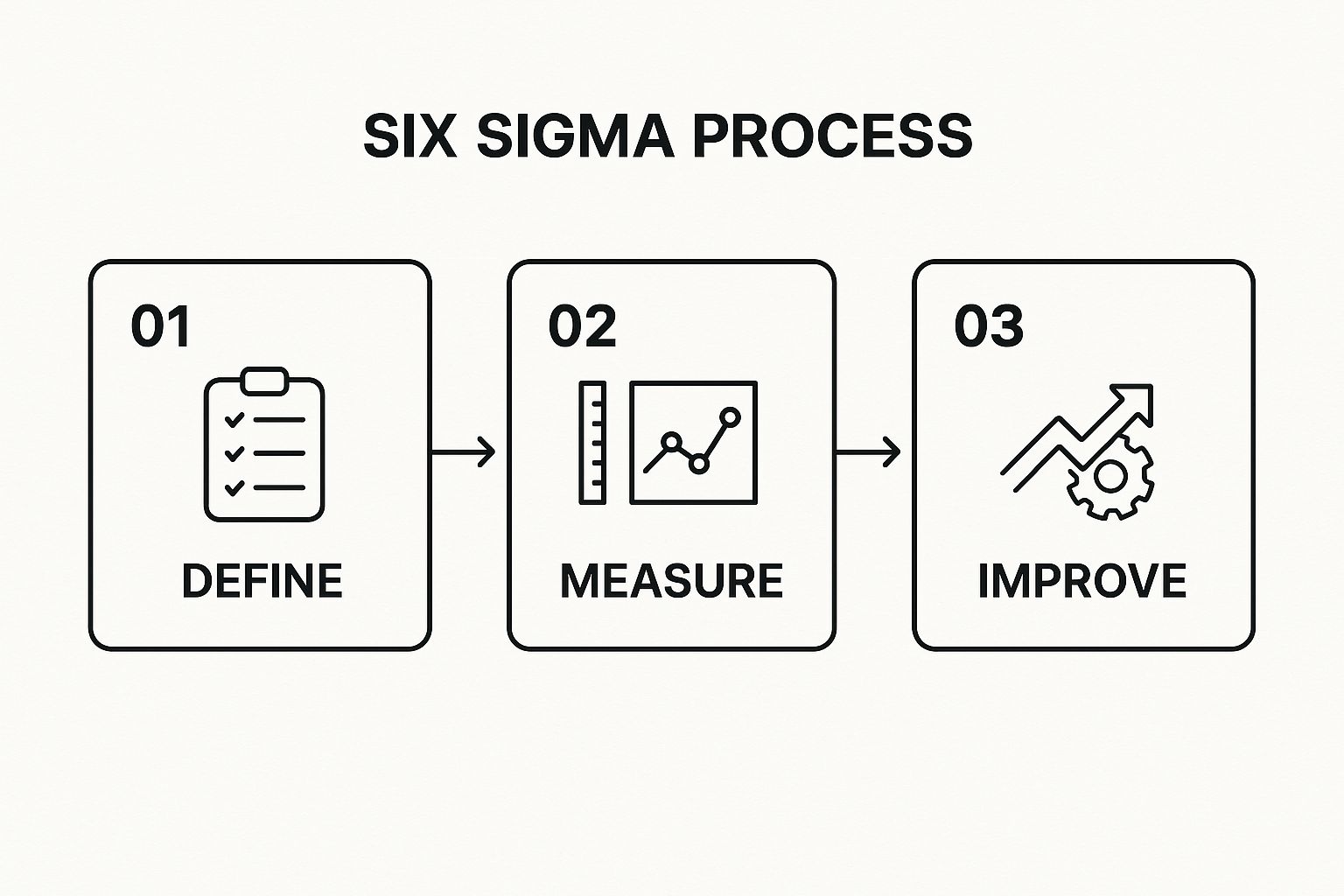
This structured flow ensures that improvements are based on solid data and analysis, not guesswork, leading to sustainable, long-term results.
2. Lean Manufacturing
Lean Manufacturing is a systematic method focused on minimizing waste within any process without sacrificing productivity. Popularized by the Toyota Production System, its primary goal is to maximize customer value by relentlessly eliminating activities that don't add value. This is achieved by identifying and removing the eight types of waste, often remembered by the acronym TIMWOODS: Transportation, Inventory, Motion, Waiting, Overproduction, Over-processing, Defects, and Skills (underutilized).

For a SaaS business, this translates to trimming unnecessary features (over-processing), reducing long wait times for customer support (waiting), or fixing inefficient code that requires excessive server resources (defects). Applying Lean principles helps streamline everything from software development to marketing campaigns, ensuring that every effort directly contributes to delivering a better product and experience for the customer. It's a powerful business process improvement technique for creating more value with fewer resources.
How to Implement Lean Manufacturing
Adopting a Lean mindset requires a commitment to continuous improvement and a focus on operational flow.
- Start with Value Stream Mapping: The first step is to map your current process from beginning to end to visualize where waste occurs. For a SaaS company, this could be the entire customer journey from trial signup to subscription renewal.
- Implement 5S Workplace Organization: A clean and organized digital or physical workspace is foundational. The 5S method (Sort, Set in order, Shine, Standardize, Sustain) can be applied to file structures, project management boards, or internal documentation to improve efficiency.
- Empower Your Team: Train employees to identify waste in their daily tasks. Foster a culture where everyone is encouraged to suggest small, incremental improvements. This bottom-up approach is key to sustaining a Lean environment.
- Focus and Iterate: Don't try to overhaul everything at once. Pick one critical area, like the feature request pipeline, apply Lean principles to improve its flow, measure the results, and then move to the next.
3. Business Process Reengineering (BPR)
Business Process Reengineering (BPR) is a radical business process improvement technique that involves completely rethinking core processes from the ground up to achieve dramatic gains. Instead of making incremental adjustments, BPR challenges existing assumptions and seeks to redesign processes to dramatically improve critical measures like cost, quality, service, and speed. It’s a "clean slate" approach popularized in the 1990s by Michael Hammer and James Champy.
For a SaaS company, BPR could mean completely overhauling the entire customer journey, from initial marketing touchpoint to renewal. Instead of simply tweaking the lead qualification workflow, you might redesign the entire sales and onboarding process to be fully self-service, eliminating traditional sales roles for a specific product tier. The goal isn't small fixes; it’s a fundamental transformation that delivers a significant competitive advantage by questioning why a process exists in its current form.
How to Implement BPR
Given its transformative nature, implementing this business process improvement technique requires careful planning and strong leadership.
- Secure Strong Executive Sponsorship: BPR initiatives are disruptive and require top-level authority to overcome resistance and allocate resources. This is a non-negotiable first step.
- Focus on High-Impact Processes: Target processes that directly influence customer satisfaction or financial performance, such as your user provisioning system or your entire feature release cycle.
- Use Technology as an Enabler: Leverage automation, AI, and new platforms to enable the new process, not just automate the old, inefficient one. The technology should support the redesigned workflow.
- Communicate and Manage Change: Be transparent about the goals and progress. Since BPR often involves significant changes to roles and responsibilities, a robust change management plan is essential. For more insight on how to prepare your processes for a major overhaul, check out our guide on business process documentation on saasoperations.com.
4. Kaizen
Kaizen is a Japanese philosophy centered on continuous, incremental improvement involving all employees, from the CEO to frontline workers. Popularized by the Toyota Production System, this business process improvement technique is not about radical, one-time changes but about making small, consistent enhancements to create significant long-term impact. The core idea is that a large number of small improvements are more effective than a few large ones.
For a SaaS company, Kaizen can be applied to refine the user interface based on daily feedback, improve the efficiency of your code deployment pipeline, or streamline internal communication workflows. For example, your engineering team could hold a brief weekly meeting to identify and implement one small process tweak that reduces build times, or the customer success team could suggest minor adjustments to email templates that improve clarity and reduce follow-up questions. It fosters a culture where everyone is empowered to improve their own work processes.
How to Implement Kaizen
Embracing this philosophy of continuous improvement requires a cultural shift towards empowerment and proactive problem-solving.
- Encourage Employee Participation: Create a system where every team member can easily suggest small improvements. This could be a dedicated Slack channel, a physical suggestion box, or a regular agenda item in team meetings.
- Start Small and Be Consistent: Focus on low-cost, low-risk changes that can be implemented quickly. The power of Kaizen comes from the cumulative effect of many small actions over time, not from a single major project.
- Celebrate and Standardize: Publicly recognize employees for their improvement suggestions, no matter how small. Once an improvement is proven effective, document and standardize it as the new best practice to ensure the gains are sustained.
5. Value Stream Mapping (VSM)
Value Stream Mapping (VSM) is a lean management technique used to visualize, analyze, and improve all the steps in a product delivery process. It documents the flow of materials and information required to bring a product or service from its beginning to the end customer. VSM provides a clear picture of the current state, helping teams identify waste, reduce process cycle times, and implement improvements to create a more efficient future state.
For a SaaS company, VSM can map the entire journey from a customer signing up for a trial to becoming a fully onboarded, paying user. By visualizing this flow, you can pinpoint bottlenecks, such as a confusing setup step or a long delay in receiving a welcome email. This business process improvement technique is powerful for identifying non-value-added activities and streamlining the customer experience, ultimately improving activation and retention rates.
How to Implement Value Stream Mapping
Adopting VSM requires a collaborative and hands-on approach to truly understand your processes.
- Walk the Process: Don’t map from a conference room. Physically or virtually walk through the actual process as it happens to gain genuine insights. For a SaaS process, this could mean following a user's click path or tracking a support ticket's journey.
- Involve All Stakeholders: Bring together team members from every stage of the value stream, from marketing and sales to customer support and engineering. This ensures a complete and accurate picture.
- Focus on High-Impact Areas: Start with a process that is causing significant problems or is critical to customer satisfaction, like your user onboarding funnel or your feature request-to-deployment pipeline.
The video below offers a great introduction to the fundamentals of Value Stream Mapping and how to get started.
By mapping the flow of value, you can systematically eliminate waste and ensure every step in your process contributes directly to what your customer needs.
6. Process Mining
Process Mining is a data-driven business process improvement technique that uses event logs from your existing software systems to visualize, analyze, and optimize how work actually gets done. It acts like an X-ray for your operations, revealing the real process flow with all its detours and bottlenecks, rather than relying on idealized process maps.
For a SaaS business, Process Mining can uncover hidden inefficiencies in your customer journey. You could analyze event logs from your CRM, support desk, and product analytics tools to see exactly how users navigate from sign-up to feature adoption, identifying where they get stuck. For instance, Siemens used this technique to reduce its order-to-cash cycle time by 15% by identifying and removing previously unseen bottlenecks in its sales and fulfillment process.
How to Implement Process Mining
Adopting this analytical technique requires a focus on data and collaboration to turn insights into action.
- Ensure Data Quality: Your analysis is only as good as your data. Start by validating the quality and completeness of event logs from critical systems like your CRM or billing platform.
- Start with a High-Impact Process: Begin with a process that has rich, accessible data and a clear business impact, such as analyzing the sales pipeline from lead to close or mapping the customer support resolution journey.
- Involve Business Users: Technical data is meaningless without context. Work closely with the teams who execute the process daily to interpret the findings and co-create solutions. This ensures the improvements are practical and address real-world challenges.
7. Design Thinking for Process Improvement
Design Thinking is a human-centered, iterative approach to problem-solving that focuses on deeply understanding the people a process serves. Popularized by design firm IDEO and the Stanford d.school, it integrates user needs with technological feasibility and business viability. When applied to business process improvement, it shifts the focus from purely optimizing metrics to enhancing the end-user experience, whether that user is a customer or an employee.
For a SaaS company, Design Thinking is an invaluable tool for refining processes like user onboarding, feature adoption, or internal workflows. For instance, IBM used it to completely overhaul their employee expense reporting process, improving the user experience and boosting satisfaction. The core idea is to empathize with the user's journey, identify their true pain points, and collaboratively develop solutions that are both effective and enjoyable to use.
How to Implement Design Thinking
Adopting this user-centric business process improvement technique requires a shift in mindset from "what is efficient?" to "what is best for the user?"
- Empathize with Users: Start by deeply understanding the user's experience. Conduct interviews, create user journey maps, and gather direct feedback to identify genuine pain points in the existing process.
- Prototype and Test Rapidly: Don't aim for perfection on the first try. Create low-cost, simple prototypes of a new process, whether it's a wireframe for a new dashboard or a flowchart for a new support system.
- Involve Cross-Functional Teams: Bring together people from different departments (e.g., product, support, engineering) to brainstorm and co-create solutions. This diversity of perspectives is key to innovative and practical process improvements.
8. Robotic Process Automation (RPA)
Robotic Process Automation (RPA) is a powerful technology that uses software 'bots' to mimic human actions and automate repetitive, rule-based digital tasks. These bots can interact with applications and systems just like a person would, from logging into applications and moving files to filling in forms and extracting data from documents. RPA is designed to handle high-volume, predictable tasks, freeing up human employees for more strategic, value-added work.
For a SaaS company, RPA is one of the most direct business process improvement techniques for boosting operational efficiency. It can be used to automate user provisioning and de-provisioning, process subscription payments, or manage routine data entry for CRM updates. For example, Telefónica automated its invoice processing with RPA and reduced the time required by 85%. The goal is to offload tedious manual work to bots that can operate 24/7 with perfect accuracy, reducing costs and accelerating processes.
How to Implement Robotic Process Automation (RPA)
Implementing this technology effectively requires careful planning to ensure a high return on investment.
- Start with Stable, High-Volume Tasks: Identify processes that are highly repetitive, rule-based, and don't change often. Good candidates include generating standard reports, processing support tickets, or handling data migration.
- Plan for Governance and Maintenance: Bots are software and require oversight. Establish a clear governance model for managing, monitoring, and maintaining your bots to handle application changes or process updates.
- Involve IT and Security Early: Since bots interact with company systems and data, it is crucial to involve your IT security team from the beginning to ensure compliance and mitigate any potential risks.
- Communicate with Your Team: Be transparent with employees about which tasks are being automated. Frame RPA as a tool that helps them focus on more interesting and creative work, not as a replacement.
By automating the right tasks, you can significantly enhance productivity. To explore this topic further, you can learn more about how RPA fits into a broader strategy in our guide to workflow automation.
9. Agile Process Improvement
Agile Process Improvement is an iterative and flexible methodology that prioritizes collaboration, customer feedback, and rapid, incremental enhancements. Borrowed from software development, this approach breaks down large-scale improvement projects into small, manageable cycles called sprints. Each sprint delivers a tangible improvement, allowing teams to adapt quickly to changing needs and learn from each iteration.
For a SaaS business, Agile is a natural fit. It can be used to continuously refine user onboarding flows, optimize the feature request pipeline, or improve the efficiency of content marketing production. For example, instead of a six-month overhaul of the customer support process, an agile team might spend two weeks implementing a new tagging system, gathering feedback, and then using that data to inform the next small improvement. This one of the most dynamic business process improvement techniques for fast-moving tech environments.
How to Implement Agile Process Improvement
Adopting this iterative methodology requires a shift in mindset from traditional, long-term project planning.
- Keep Improvement Cycles Short: Plan improvements in short sprints, typically lasting 2-4 weeks. This forces focus and delivers value quickly.
- Involve End-Users Constantly: Make stakeholders and end-users an integral part of the process, gathering their feedback at the end of each sprint to guide the next steps.
- Focus on Working Solutions: Prioritize delivering a functional improvement over creating exhaustive documentation. The goal is progress, not perfection.
- Hold Regular Retrospectives: After each sprint, the team should meet to discuss what went well, what didn't, and how to improve the improvement process itself.
Agile is a core component of modern SaaS operations management. To learn more about how it fits into the broader framework, you can explore SaaS operations management in detail. This approach ensures that your processes evolve alongside your product and customer base.
10. Theory of Constraints (TOC)
The Theory of Constraints (TOC) is a management philosophy that views any complex system as being limited in achieving more of its goals by a very small number of constraints. Popularized by Eliyahu M. Goldratt in his novel "The Goal," TOC asserts that every process has a single bottleneck, and focusing improvement efforts on that constraint is the fastest path to significant overall improvement.
For a SaaS business, the constraint might be the development team's capacity to ship new features, the number of qualified leads your marketing team can generate, or the speed of your customer support team's response. For instance, if your customer onboarding process is the bottleneck holding back revenue growth, TOC dictates that you should focus all available resources on streamlining that specific stage, rather than thinly spreading efforts across the entire customer journey.
How to Implement Theory of Constraints
Adopting this business process improvement technique requires a laser-focus on identifying and elevating your system's weakest link.
- Identify the Constraint: Use data to pinpoint the single part of the process that limits the entire system's throughput. A gap analysis can be an effective tool for identifying these performance bottlenecks. Learn more about how you can perform a gap analysis.
- Exploit the Constraint: Ensure the bottleneck is operating at its maximum capacity. Don't let it sit idle or work on low-priority tasks. Its time is the most valuable in the entire system.
- Subordinate Everything Else: Align all other processes to support the constraint. Non-bottleneck parts of the system should operate at the pace of the constraint, not at their own maximum speed, to avoid creating new problems like excess inventory or work-in-progress.
- Elevate the Constraint: If the constraint still limits the system after the first three steps, invest in improving it. This could mean adding resources, upgrading technology, or redesigning the process.
- Repeat the Process: Once a constraint is resolved, a new one will emerge. The process is a continuous cycle of identifying and addressing the next bottleneck to drive ongoing improvement.
Top 10 Business Process Improvement Techniques Comparison
| Methodology | Implementation Complexity 🔄 | Resource Requirements ⚡ | Expected Outcomes 📊 | Ideal Use Cases 💡 | Key Advantages ⭐ |
|---|---|---|---|---|---|
| Six Sigma | High – structured DMAIC phases, certified belts | High – training, statistical tools | High quality, defect reduction, ROI | Complex, data-rich, customer-focused processes | Data-driven, measurable improvements, continuous improvement culture |
| Lean Manufacturing | Moderate – cultural change, waste elimination | Moderate – training, employee involvement | Waste reduction, improved flow, efficiency | Manufacturing, supply chain, production systems | Waste minimization, faster delivery, employee empowerment |
| Business Process Reengineering (BPR) | Very High – radical redesign, disruptive | Very High – resources, change management | Dramatic performance improvement (10x+) | Processes needing breakthrough change | Breakthrough results, technology leverage, eliminates redundancies |
| Kaizen | Low – continuous small changes | Low – employee involvement, training | Incremental improvements, sustained culture | Organizations emphasizing gradual, ongoing improvement | Low risk, high engagement, builds improvement culture |
| Value Stream Mapping (VSM) | Moderate – detailed mapping, cross-team effort | Moderate – collaborative sessions | Visual process insights, waste identification | Processes needing flow optimization and waste removal | Holistic view, team alignment, clear improvement roadmap |
| Process Mining | High – data quality, technical interpretation | High – specialized software and expertise | Real process discovery, bottleneck ID, compliance | Data-rich, monitored processes with event logs | Objective insights, continuous monitoring, evidence-based |
| Design Thinking for Process Improvement | Moderate – human-centered, iterative | Moderate – team collaboration, facilitation | User-focused innovation, satisfaction improvement | Customer-centric, creative problem solving | User empathy, rapid prototyping, innovative solutions |
| Robotic Process Automation (RPA) | Moderate – automation set up, bot maintenance | Moderate – software licenses, IT support | Cost reduction, speed, accuracy | Repetitive, rule-based digital tasks | Fast ROI, accuracy increase, frees human resources |
| Agile Process Improvement | Moderate – short iterations, cultural adoption | Moderate – team training, ongoing collaboration | Rapid improvements, flexibility | Dynamic, evolving processes needing frequent updates | Fast delivery, adaptability, collaborative teams |
| Theory of Constraints (TOC) | Moderate – system analysis, ongoing management | Moderate – leadership focus, data analysis | Improved throughput, bottleneck elimination | Systems limited by bottlenecks | Focused improvements, clearer priorities, sustainable advantage |
Putting Process Improvement into Practice
You've just explored a comprehensive arsenal of ten powerful business process improvement techniques, from the data-driven precision of Six Sigma to the human-centric approach of Design Thinking. The journey from knowing these methodologies to actually leveraging them is where true transformation begins. It's not about implementing all ten frameworks at once; it's about making a strategic choice.
The real power lies in selecting the right tool for the job. Is your SaaS startup struggling with a bottleneck in your user onboarding sequence? The Theory of Constraints (TOC) could be your guide. Are you seeing consistent, minor issues bogging down your customer support team? Kaizen offers a path to incremental, sustainable fixes. The key is to diagnose the problem accurately before prescribing a solution.
Your First Actionable Steps
Instead of feeling overwhelmed by the options, focus on building momentum. Lasting change starts with a single, successful initiative that demonstrates value and inspires confidence across your team.
Here’s a simple, three-step plan to get started:
- Identify a High-Impact Process: Pinpoint one area causing significant friction or inefficiency. This could be anything from your lead qualification workflow to your monthly financial closing process. Look for processes that are slow, error-prone, or frustrating for your team.
- Select a Matching Technique: Review the techniques covered in this article and choose the one that best fits the problem. For visualizing waste in your sales funnel, Value Stream Mapping (VSM) is ideal. For a radical overhaul of an outdated system, Business Process Reengineering (BPR) might be necessary.
- Launch a Pilot Project: Define a clear scope, set measurable goals (e.g., "reduce customer ticket resolution time by 20%"), and assign a small, dedicated team. Document your progress and celebrate the wins, no matter how small.
Cultivating a Culture of Continuous Improvement
Ultimately, adopting these frameworks is about more than just fixing a single broken process. It's about fundamentally shifting your company’s DNA towards a culture of continuous improvement. When your team is empowered to question the status quo, identify inefficiencies, and test new solutions, you create a resilient, agile organization. This proactive mindset is a significant competitive advantage in the fast-paced SaaS industry.
To go deeper into the core principles that underpin many of these frameworks, understanding various business process improvement methods can provide additional foundational context. By embedding these practices into your daily operations, you stop fighting fires and start building a more efficient, scalable, and customer-centric business that is built to last.
Ready to move from theory to execution without reinventing the wheel? SaaS Operations provides a library of battle-tested playbooks, SOPs, and frameworks designed to help you implement these business process improvement techniques faster and more effectively. Visit SaaS Operations to access the tools you need to build a world-class operational engine for your SaaS company.