The Actionable Playbook for B2B SaaS Lead Generation
 Published By: Alex
December 6, 2025
Published By: Alex
December 6, 2025
B2B SaaS lead generation is the process of identifying, attracting, and converting businesses into qualified prospects for your software. It's not just about building a contact list; it's about engineering a predictable system that turns initial interest into revenue. This is the engine that drives sustainable growth.
Think of it as a strategic framework designed to build a predictable pipeline. Your goal is to move beyond random tactics and create a cohesive machine that consistently delivers high-quality sales opportunities.
Your Blueprint for a Predictable Revenue Engine
This is not a list of generic tips. This is an operator's guide to building a B2B SaaS lead generation engine that drives measurable, long-term growth. We'll skip the high-level theory and dive straight into the actionable playbooks and frameworks used by top-tier SaaS companies to fill their pipelines with high-value leads.
Many SaaS companies get trapped in a cycle of ineffective tactics. They burn cash on paid ads with poor conversion rates or send out generic cold emails that yield a meager 1% response rate. These approaches fail because they aren't part of an integrated system. The objective isn't just acquiring more leads; it's about attracting the right leads—those who become loyal, high-value customers.
The Modern Lead Generation Framework
A winning strategy integrates multiple channels into a single, powerful system. It’s not about choosing one tactic over another; it’s about creating a machine where each part amplifies the others. The three core pillars are:
- Inbound Magnetism: Pull prospects toward you with high-value content and targeted SEO. When your ideal customer searches for a solution, they find you first.
- Product-Led Signals: Use your product as a lead generation tool. Free trials or freemium models allow you to identify users showing strong buying intent through their in-app behavior.
- Precision Outreach: Execute targeted, multi-channel campaigns to engage specific, high-value accounts. This is about starting conversations, not just sending messages.
This diagram illustrates how these pillars work together in a modern, holistic lead generation process.
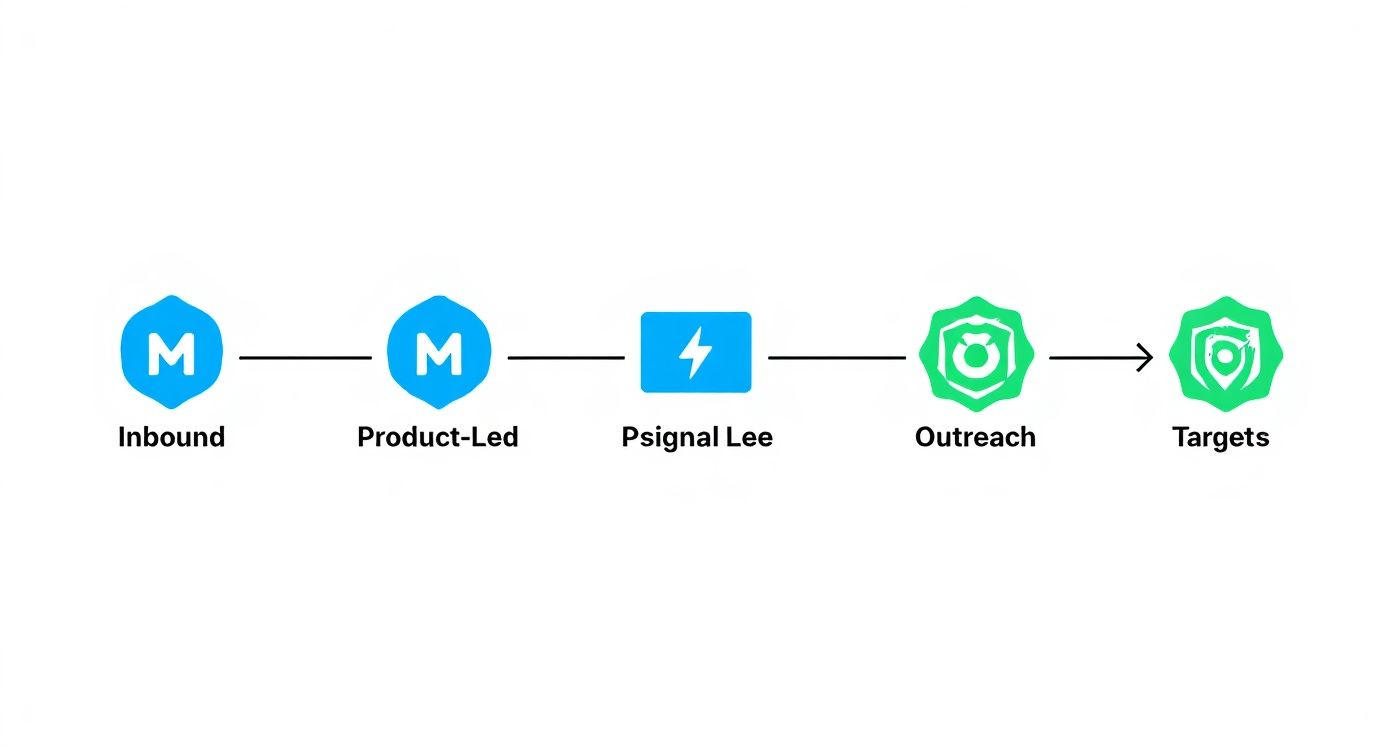
By integrating these strategies, you create a resilient and scalable growth engine that captures leads from every angle.
This guide will provide actionable steps for each stage of the lead lifecycle, from the first touchpoint to a sales-qualified opportunity. To implement these strategies effectively, see our guide on building powerful SaaS playbooks. For more actionable strategies, you can also explore these B2B Lead Generation Best Practices.
Now, let's build your inbound engine.
Building Your Inbound Engine with Content and SEO
An inbound strategy, powered by high-value content and strategic SEO, is your most sustainable and cost-effective source for B2B SaaS lead generation. This isn't about simply publishing blog posts; it's about constructing a system that consistently attracts prospects who are actively searching for your solution.
This approach transforms your website from a digital brochure into an automated lead generation machine, delivering qualified opportunities without relying on a massive ad budget.
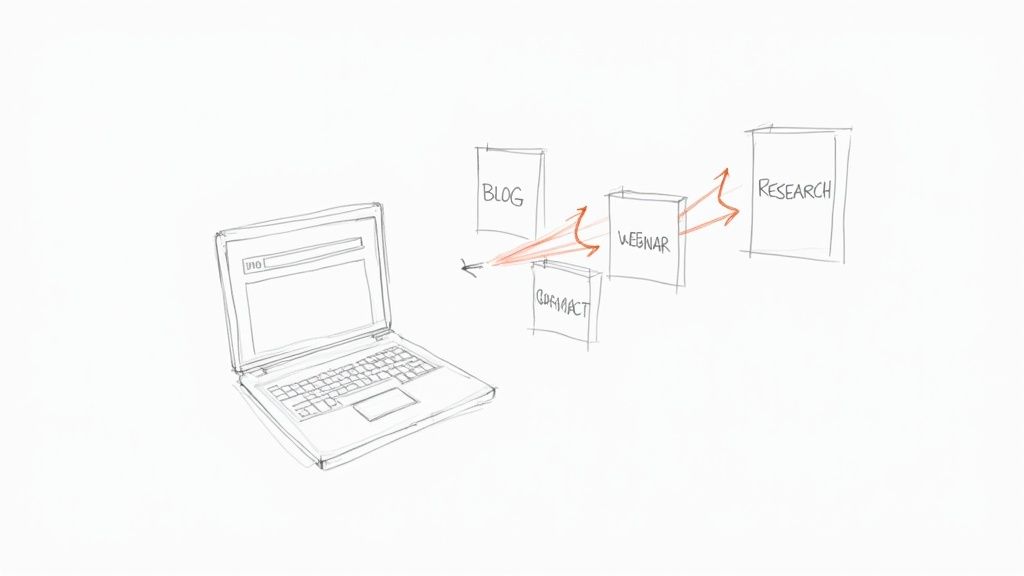
From Content To Customers: The Authority Playbook
The most successful SaaS operators don't just sell; they educate. They build trust and authority by publishing content that solves their audience's most pressing problems.
Case Study: Ahrefs
Ahrefs became a dominant force in the SEO industry not through ads, but by creating the industry's most valuable blog and YouTube channel. They teach SEO so effectively that prospects naturally conclude their software is the best tool for the job. Their content is their primary lead generation channel.
Case Study: Gong
Gong created the "revenue intelligence" category by publishing original, data-driven research that sales leaders couldn't find anywhere else. By becoming the definitive authority on sales conversations, their software became the logical choice for any team looking to improve its sales process.
Crafting High-Impact Content That Actually Works
To replicate this success, you must create content "assets" that attract, engage, and convert visitors into leads. Different formats serve different stages of the buyer's journey. Here's a tactical breakdown of content types for a B2B SaaS strategy.
High-Impact Content Formats for B2B SaaS
| Content Format | Funnel Stage | Primary Goal | Example Company & Use Case |
|---|---|---|---|
| Problem-Solving Blog Posts | Top/Middle | Attract organic traffic, answer specific user questions | Drift: Creates blog content targeting "conversational marketing" keywords, drawing in marketers looking for chatbot solutions. |
| Original Research & Reports | Top/Middle | Generate authority, earn backlinks, capture emails | HubSpot: Publishes the annual "State of Marketing Report," becoming a go-to resource for industry data and trends. |
| Webinars & Live Demos | Middle/Bottom | Educate on a deeper level, demonstrate product value | Salesforce: Hosts frequent webinars on niche topics like "AI for Sales Teams," leading directly to product demos. |
| In-Depth Guides & Ebooks | Middle | Capture leads, nurture interest, showcase expertise | Intercom: Offers comprehensive guides on "Customer Support," positioning themselves as experts and collecting leads. |
By strategically deploying these formats, you build a content ecosystem that meets buyers at every stage of their journey and builds trust with each interaction.
The Data: Content marketing generates three times more leads than traditional outbound marketing while costing 62% less. SEO leads have a close rate of 14.6%, versus just 1.7% for outbound leads. Discover more lead generation statistics and trends.
Don't Just Create—Convert
Creating high-value content is only the first step. Every piece must guide visitors toward a logical next action. Place strategic calls-to-action (CTAs) that align with the prospect's stage in the buying journey.
- Action Step: For a top-of-funnel blog post, your CTA should be a low-commitment offer, like downloading a related ebook.
- Action Step: For a bottom-of-funnel comparison article, the CTA must be a direct "Request a Demo" or "Start Free Trial." This entire journey is a core part of a well-defined SaaS sales funnel.
To maximize organic reach and lead quality, partnering with the best SEO consultant for B2B companies can accelerate your results. An expert will ensure your technical SEO, content strategy, and on-page optimizations are aligned to capture high-intent organic searches, turning your website into a predictable lead generation machine.
Outbound Strategies That Actually Work
Modern outbound for B2B SaaS lead generation is not about mass email blasts; it's about initiating targeted conversations through hyper-personalized, multi-channel campaigns. The goal is to get a reply and open the door to a qualified sales opportunity.
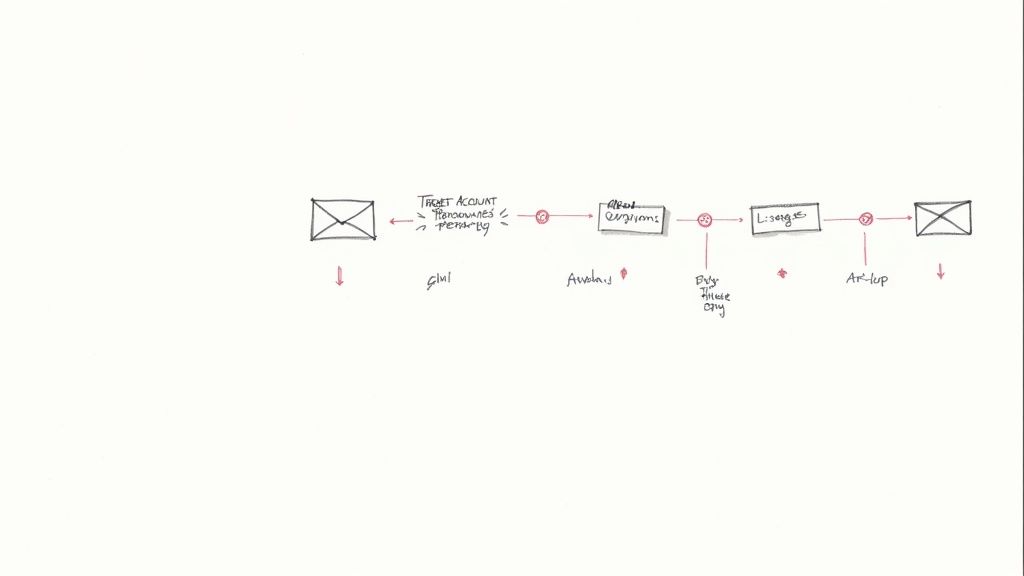
Building Your Targeted Account List
A successful outbound campaign starts with a surgically precise list of target accounts. This is the foundation of Account-Based Marketing (ABM). Go beyond industry and company size by identifying buying triggers—events that indicate an immediate need for your solution.
Actionable Buying Triggers to Monitor:
- Recent Funding Rounds: Companies with fresh capital are actively looking for tools to accelerate growth.
- Key Hires: A new VP of Sales or Head of Marketing will immediately evaluate and upgrade their team's tech stack.
- Technology Signals: Use a tool like BuiltWith to identify companies using a competitor's product or a complementary technology.
When you base your outreach on these triggers, you are no longer cold calling; you are engaging at the exact moment of need.
Crafting Outreach That Resonates
With your target list, the next step is to craft a message that cuts through the noise. True personalization goes beyond {{first_name}}. It demonstrates you've done your research. A high-performing cold email focuses on the prospect's problem, not your product.
Actionable Email Template (Trigger-Based):
"Hi [Name],
Saw that [Company Name] just hired a new Head of Customer Success—congrats on the growth!
Typically, when a CS team scales that quickly, keeping customer data clean across different platforms becomes a major headache.
We help SaaS teams like yours sync customer data automatically, saving them about 10 hours a week on manual admin work. Worth a quick chat?"
This email works because it is timely, relevant, and directly addresses a probable pain point. For more templates and cadences, our guide on building an effective cold email sequence provides battle-tested examples.
A Multi-Channel Playbook
The most effective outbound playbooks use a mix of channels, such as email and LinkedIn, to create multiple touchpoints without being intrusive.
Actionable Cadence to Implement:
- Day 1 (LinkedIn): Send a personalized connection request. Do not pitch. Mention a mutual connection or a recent piece of their content.
- Day 3 (Email): Send your trigger-based cold email.
- Day 5 (LinkedIn): Follow up on LinkedIn. Briefly reference your email and ask a simple, open-ended question related to their role.
- Day 8 (Email): Send a follow-up email that provides value—a relevant case study, a short video explaining a concept, or a link to a helpful blog post.
This multi-channel approach increases visibility and builds trust by positioning you as a helpful expert, effectively warming up a cold prospect.
The Power of Automation and Lead Nurturing
Acquiring a lead is just the beginning. The process of converting that interest into a paying customer is where automation and lead nurturing are essential. This system works behind the scenes to ensure no prospect is forgotten and guides them toward a sales conversation.
Lead nurturing builds a relationship over time through automated, value-driven touchpoints. It’s the system that ensures your initial investment in lead generation pays off.
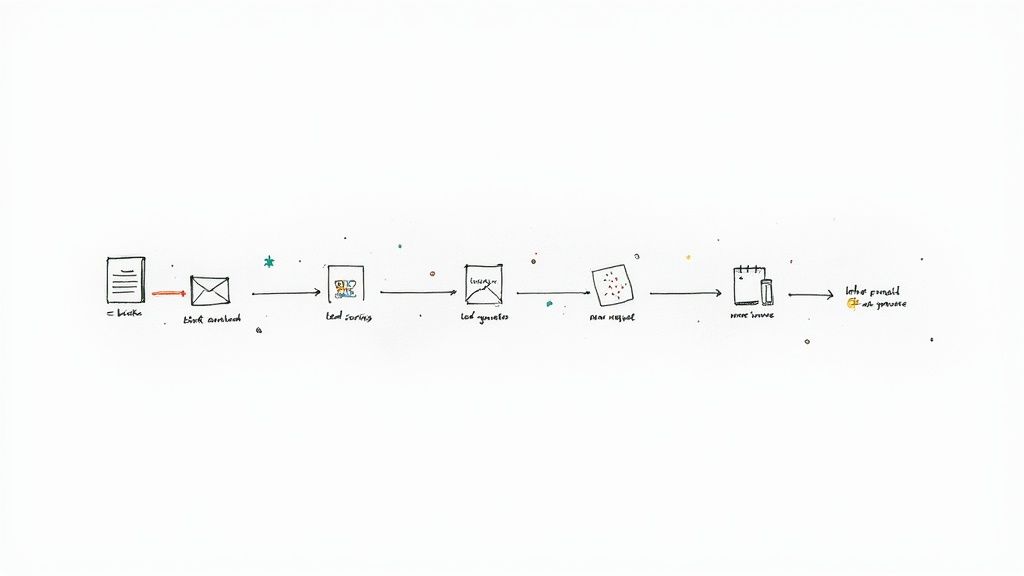
Building Your Automated Nurture System
Marketing automation is the core of an effective nurturing strategy. It's about delivering the right message to the right person at the right time, based on their behavior. For a detailed guide, read our article on marketing automation for SaaS.
The Data: Companies excelling at lead nurturing generate 50% more sales-ready leads at a 33% lower cost. Yet, 65% of B2B companies have no formal lead nurturing process. This is a massive competitive advantage. Following up with a lead within five minutes makes them nine times more likely to convert—a feat impossible without automation.
Prioritizing Leads with Lead Scoring
Not all leads are created equal. A prospect who downloaded an ebook is less qualified than one who visited your pricing page three times. Lead scoring is the system that automatically differentiates them. It assigns points to leads based on their demographic data and engagement, allowing your sales team to focus on the hottest prospects.
Actionable Lead Scoring Model:
- Demographic Scoring:
- +10 points for "Director" level or higher.
- +5 points for a company in a target industry.
- -10 points for a personal email address (e.g., @gmail.com).
- Behavioral Scoring:
- +15 points for a demo request.
- +10 points for visiting the pricing page.
- +5 points for opening a marketing email.
- +3 points for downloading a whitepaper.
Once a lead reaches a predefined threshold (e.g., 50 points), they are flagged as a Sales Qualified Lead (SQL) and automatically routed to a sales representative for immediate follow-up.
The Ebook Download to Demo Request Playbook
Here's how this works in practice. A Marketing Manager, Sarah, downloads your "Ultimate Guide to ABM." She's interested but not yet ready to buy. Your automated nurture sequence begins.
- Instant Delivery (Email 1): Immediately after downloading, an email delivers the ebook and suggests a related blog post. No sales pitch.
- Value-Add (Email 2 – Day 3): A few days later, an automated email shares a case study of a similar company that achieved significant ROI with your software, connecting the ebook's concepts to real-world results.
- Deeper Engagement (Email 3 – Day 7): Sarah receives an invitation to a webinar on "Scaling Your ABM Strategy," offering more in-depth knowledge and showcasing your expertise.
- The Ask (Email 4 – Day 12): If Sarah attended the webinar (a strong buying signal), a sales rep receives a notification to send a personalized email offering a one-on-one strategy session. If she didn't, the automated sequence continues with more valuable content.
This entire process happens automatically. The system educates the prospect, builds trust, and guides them down the funnel, converting a cold ebook download into a warm, sales-ready demo request. This is the core of a scalable B2B SaaS lead generation engine.
Running Paid Campaigns Without Breaking the Bank
https://www.youtube.com/embed/ol0v779BlAA
When executed with precision, paid acquisition becomes a predictable, scalable machine for generating high-quality B2B SaaS leads. Success depends on surgical targeting and relentless optimization, not an unlimited budget. The goal is to deliver the right message to the right decision-maker at the moment they are actively seeking a solution.
For B2B SaaS, two platforms consistently deliver the best results: Google Ads and LinkedIn Ads.
Mastering The Top B2B Ad Platforms
Google Ads is ideal for capturing high-intent leads—prospects actively searching for a solution.
- Action Step: Avoid broad, expensive keywords like "project management software." Instead, target long-tail keywords like "collaboration tool for remote engineering teams." The search volume is lower, but the lead quality is significantly higher.
LinkedIn Ads offers unparalleled demographic targeting.
- Action Step: Zero in on prospects by job title, company size, industry, and seniority. This allows you to reach a "VP of Sales at a Series B fintech company" with an ad specifically designed to address their unique challenges.
The Data: The average cost per lead (CPL) for B2B SaaS from paid channels is around $310. This high cost makes performance optimization essential.
B2B SaaS Lead Generation Channel Comparison
This comparison breaks down the top channels by cost, lead quality, and scalability to help you allocate your budget effectively.
| Channel | Average CPL (Cost Per Lead) | Typical Lead Quality | Scalability | Best For |
|---|---|---|---|---|
| Google Ads | $100 – $350 | High (Intent-driven) | High | Capturing active demand from people searching for a solution. |
| LinkedIn Ads | $150 – $400+ | Very High (Precise targeting) | Medium | Reaching specific decision-makers in target accounts (ABM). |
| Content Syndication | $40 – $120 | Low to Medium | High | Generating a high volume of top-of-funnel leads quickly. |
| Cold Outreach | $200 – $500 | High (Highly personalized) | Low | Hyper-targeted campaigns for high-value enterprise accounts. |
| Affiliate/Partnerships | Varies (Often Rev-Share) | Medium to High | Medium | Tapping into an existing audience through a trusted source. |
A combination of these channels typically yields the most robust lead generation engine.
From Click to Conversion: The Money Metrics
Effective paid campaigns are measured by revenue, not clicks. Focus on the metrics that directly impact your bottom line.
Actionable Metrics to Track:
- Cost Per Lead (CPL): The cost to acquire a single lead from your campaign. This is your baseline for ad efficiency.
- Customer Acquisition Cost (CAC): The total cost to acquire a new paying customer, including all sales and marketing expenses. Your CAC must be significantly lower than your Customer Lifetime Value (LTV) for your business to be profitable.
- Return on Ad Spend (ROAS): Calculated as (Revenue from Ads / Cost of Ads), this metric shows the direct return on your advertising investment.
These numbers provide actionable insights. A high CPL may indicate your targeting is off or your ad copy is ineffective. A high CAC might point to inefficiencies in your sales process. Our customer acquisition cost calculator can help you master this critical metric. By monitoring these figures closely, you can make data-driven decisions to continually optimize your campaigns for profitability.
Got Questions About B2B Lead Gen? We've Got Answers.
Navigating B2B SaaS lead generation can be complex. Here are actionable answers to the most common questions from SaaS operators.
How Many Leads Should My New SaaS Actually Aim For?
In the early stages, focus on quality over quantity. Instead of targeting 100 generic leads per month, aim for 5-10 highly qualified demo requests from companies that perfectly match your Ideal Customer Profile (ICP). Your primary goal is to learn and validate your market, not just fill your funnel.
Action Step: Determine your lead-to-customer conversion rate. If it takes 20 qualified leads to close one new customer, and your goal is two new customers this month, your target is 40 qualified leads. Work backward from your revenue goals to set a realistic lead target.
There Are So Many Channels. Where Do I Even Start?
Start where your customers are. If your ideal buyers are active on LinkedIn, a targeted outbound strategy is your best starting point. If they are constantly searching for solutions on Google, prioritize content marketing and SEO.
Actionable Test Plan: Allocate a small budget and run three tests simultaneously:
- Launch a micro LinkedIn Ad campaign targeting a core job title.
- Publish three in-depth blog posts targeting high-intent, long-tail keywords.
- Send 50 hyper-personalized cold emails based on buying triggers.
After two weeks, analyze the results. Double down on the channel that generates the highest quality engagement and conversations.
What's the Real Difference Between an MQL and an SQL?
Defining these terms clearly is critical for aligning your sales and marketing teams.
A Marketing Qualified Lead (MQL) is a prospect who fits your target profile and has engaged with your marketing materials (e.g., downloaded an ebook, attended a webinar). They have shown interest but have not yet signaled an intent to buy.
A Sales Qualified Lead (SQL) is an MQL who has taken an action that indicates active buying intent. This includes requesting a demo, filling out a "contact sales" form, or repeatedly visiting your pricing page. An SQL is ready for a direct conversation with a sales representative.
Ready to stop guessing and start building a predictable revenue engine? SaaS Operations gives you the proven playbooks, templates, and SOPs you need to scale without the chaos. Explore our battle-tested frameworks and see how we can help.